

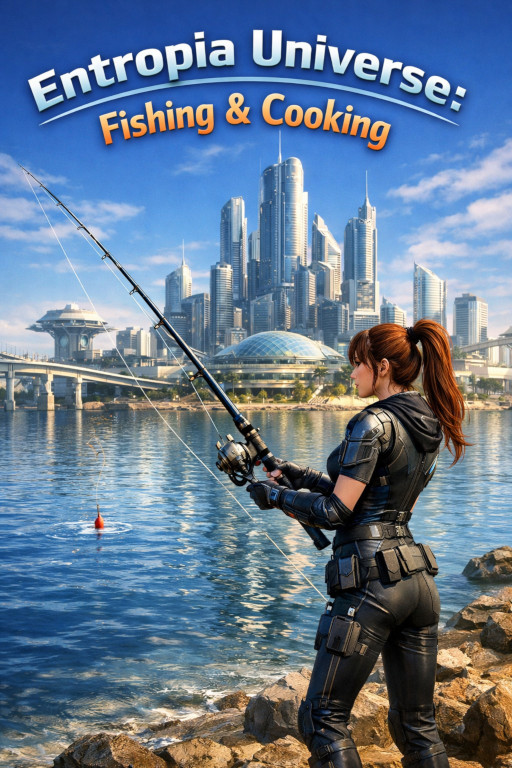
Entropia Universe: A Beginner’s Guide to Fish Scrap, Bass Oil, and Early Cooking
Fishing and cooking are still new systems in Entropia Universe, and reliable information is scarce. Much of what’s circulating online is outdated, incomplete, or based on assumptions. This post covers only what has been personally verified in‑game — no speculation, no filler.
NOTE: Space travel is a risky proposition. All of space except for small areas around space stations and just outside planets is a lootable zone if you are shot down by pirates. Do not carry anything in your inventory that is under the Materials or Resources tabs or it can be looted. Entropia automatically places lootable items in these tabs. If you are killed, you will lose all of what is in those tabs.
This is my current understanding and what I decide to carry into space from my Quad Wing Interceptor verses pay the fee for a warp ship to carry me to other locations in space.
How to Get Started
Fishing and cooking in Entropia Universe are shaping up to be deeper systems than they first appear. Even at this early stage, there is a clear, verified progression path:
1. Begin on Setesh
Learn the fishing mini‑game
Catch your first fish
Collect Fish Scrap
Receive the blueprint needed to craft Spool Cells
Complete the introductory cooking missions
Cook at campfires until Level 2
Unlock the need for a Personal Cooking Unit (PCU)
2. Move to Port Atlantis
Travel to the Port Atlantis teleporter
Follow the path to the baitfishing NPC
Receive your free (L) baitfishing rod
Learn how to catch baitfish
Understand that baitfish appear in the Resources tab
Use the Spool Cell blueprint from Setesh to craft the ammo needed for baitfishing when you choose to.
3. Establish the Core Loop
Once you’ve completed both parts of the introduction, the early fishing/cooking loop becomes:
Catch fish
Collect Fish Scrap
Refine fish + scrap into oils (meeting the species‑specific requirements)
Use oils in Cooking blueprints
Progress from campfires to PCUs as your Cooking level increases
Catch baitfish using the Port Atlantis rod and the Spool Cells you craft; use baitfish in crafting additional Spool Cells.
- Do Fishing Dailies on Calypso by going to /wp [Calypso, 61426, 74266, 100, Fishing Dailies] in Port Atlantis on the coast. This is only the location of the Fishing Daily NPCs you receive the missions from.
- Pick Up Fishing Blueprints from the same waypoint. Just look next to the NPCs for the blueprint terminal or at any Technician NPC on Calypso. Many different types of gear and lures can be found on the auction under Fishing. You can receive blueprints as rewards for doing the dailies.
This loop is simple enough to get started with, but it clearly has room to grow as more fish species, oil types, and cooking recipes are discovered and verified.
Everything beyond this point — higher‑tier fish, advanced cooking, long‑term crafting loops — will be added as it is confirmed in‑game.
If you’re trying to understand how Fish Scrap, refining, and early cooking actually work, this is the confirmed foundation you can build on.
Fish Scrap Works is Confirmed to Work on Planet Calypso and Setesh.
NOTE: Fishing and baitfishing is not currently supported on Planet Toulan according to this post: https://www.virtualsense.eu/forum/threads/toulan-monthly-event-fri-jun-26th-sun-jun-28th-the-reprieve-is-over.11042/
While it is true, this was an announcement on the Virtual Sense forum as of June 28, 2026, this blog post will be updated once new information becomes available.
You can purchase a boat to reach deeper water, which allows you to target better fish species. You will need a rod, reel, blank, line, and lure meant for deeper water and stronger fish, for example: eels – a mission you are given right away by one of the AI NPCs.
Fish Scrap is fully functional on Calypso, and you can refine it there without any special equipment or planet‑specific restrictions.
The confusion comes from the fact that Fish Scrap uses the exact same icon as Tailoring Remnants. Fish Scrap appears in the Materials tab and is visually identical to Tailoring Remnants. The only way to tell them apart is by hovering your mouse over the stack and reading the item name. Because of this, it’s extremely easy to overlook Fish Scrap entirely and assume you didn’t receive any — especially if your inventory is cluttered.
Refining Fish Scrap Into Oil
Refining isn’t as simple as “collect scrap and press refine.” Each fish species has two requirements:
A minimum number of fish of that species
A specific amount of Fish Scrap
A refining tool
For every species I’ve tested so far, the minimum fish count has been 10 fish of that species. This may not apply to every fish in the game, but it applies to all species I’ve personally caught.
One Example: Juvenile Bass
To refine Juvenile Bass into Bass Oil, you need:
10 Juvenile Bass
12,000 Fish Scrap
Once both requirements are met, you refine them in a standard refiner that can be purchases from the Trade Terminal — nothing special needed.
The output is Bass Oil, which is used in Cooking blueprints.
Where Cooking Blueprints Come From
Cooking BPs aren’t random drops. They come from cooking missions, which introduce you to the system and give you the first recipes you’ll need.
These missions also place you right next to the tools you’ll use early on.
Campfires and the Personal Cooking Unit (PCU)
Cooking has two stages:
1. Campfires (Cooking Level 1–2)
You can cook at campfires until you reach Cooking Level 2. These are found near the NPCs who give the cooking missions.
2. Personal Cooking Unit (PCU) (Level 2+)
After Level 2, you must cook on a Personal Cooking Unit.
Important details:
The PCU is crafted furniture, not a public terminal.
It must be placed in an estate.
MindArk has stated they may charge a usage fee for PCUs in the future. (This is not active yet, but it’s their stated intention.)
If you plan to cook long‑term, owning or having access to a PCU will matter.
What We Know — and What We Don’t
Everything above is confirmed through direct gameplay.
What we do not know yet:
Whether all fish require exactly 10 specimens
The scrap requirements for species beyond those tested
How higher‑level cooking behaves
Whether PCU usage fees will be implemented
The full list of cooking recipes and their outputs
As more players test the system — or as MA releases official documentation — these gaps will fill in. For now, this post reflects the accurate, verified starting point for anyone wanting to explore fishing and cooking without misinformation.
How a Rod Is Assembled and What Each Part Does
Fishing rods in Entropia Universe are modular tools made up of several components. Each part contributes specific stats that determine how well you can cast, hook, and fight fish. There are two distinct rod types in the current system:
Baitfishing Rods — use Spool Cells as ammo and are used to catch baitfish.
Standard (L) Angler Rods — use lures, not Spool Cells, and are used to catch regular fish.
Baitfish are used in crafting Spool Cells. Spool Cells are the ammo required exclusively for the baitfishing rod. Standard rods do not use Spool Cells at all. Any additional uses of baitfish, such as cooking, are not yet fully verified and are therefore not assumed here.
Rod Components
A complete rod setup consists of the following parts:
Rod — the base item that determines compatibility with reels, blanks, lines, and lures.
Reel — provides Strength and Speed.
Blank — provides Strength and Flexibility.
Line — provides Flexibility, Strength, and Length.
Lure (standard rods only) — provides Depth and Quality.
What Each Stat Does
Lure Stats (Standard Rods)
Depth — must meet or exceed a fish’s minimum depth to trigger a bite.
Quality — increases the chance of a bite.
Reel Stats
Strength — directly compared to the fish’s strength; determines how difficult the fight is.
Speed — affects how quickly you can reel during the minigame.
Blank Stats
Strength — contributes to overall tension during the fight.
Flexibility — affects how far the fish can swim away.
Line Stats
Flexibility — influences casting distance and how the fish moves during the fight.
Strength — contributes to tension and determines how long the line can withstand strain.
Length — affects maximum casting range.
How Stats Combine
Total Flexibility (blank + line + rod) determines casting distance and fish movement.
Total Strength (blank + line + rod) affects tension and fight duration.
Reel Strength is compared directly to the fish’s strength to determine difficulty.
Together, these parts and stats determine how effectively you can cast, hook, and land fish — whether you’re using a lure‑based angler rod or a Spool Cell‑powered baitfishing rod.
Daily Fishing Missions & Trader Joel Travel Route
The current fishing loop spans both Calypso and Setesh. You’ll handle your daily fishing missions entirely in Port Atlantis, while Trader Joel on Setesh remains your go‑to for Setesh daily mission needs. Setesh is the newest starting zone for new players entering Calypso.
Getting & Turning In Daily Fishing Missions (Port Atlantis, Calypso)
To start your daily fishing routine, you’ll need to travel to Calypso. The simplest route is:
- Travel to Calypso Space Station.
- Use the Calypso Space Station teleporter to teleport down to Calypso.
- Head to Port Atlantis to pick up your daily fishing missions.
After completing your fishing objectives, return to Port Atlantis and turn in the daily missions at the same NPC or terminal. Both the pickup and turn‑in happen right there, keeping the daily loop simple and efficient.
Visiting Trader Joel (Setesh)
For Setesh daily missions you’ll need to visit Trader Joel on Setesh. Getting there requires a short interplanetary hop:
- Travel to Setesh Space Station.
- Use the Setesh Space Station teleporter to teleport down to Setesh.
- Navigate to Trader Joel’s location using the waypoint below.
For fast navigation, use this waypoint command in chat:
/wp [Setesh, 67821, 68118, 268, Trader Joel]With both locations in mind, your overall loop looks like this:
- Calypso: Teleport down → Port Atlantis → pick up & turn in daily fishing missions.
- Setesh: Teleport down → visit Trader Joel for trading and inventory.
This setup keeps your fishing routine smooth while giving you easy access to both mission progression and trading opportunities.
Final Thoughts
Fishing and cooking in Entropia Universe are still evolving systems, and the early days always come with confusion, missing details, and outdated assumptions. What’s written above reflects only what has been directly verified in-game — the real mechanics, the real requirements, and the real progression path players can rely on right now.
As more fish species are discovered, more oils are refined, and more cooking recipes become available, the system will naturally expand. The same is true for Spool Cells, baitfishing, and the long-term crafting loops that will eventually tie everything together. For now, the foundation is solid: catch fish, refine scrap, cook what you can, and build upward from confirmed information rather than speculation.
I’ll update this post as I verify additional details through direct gameplay, so the information here remains accurate as the system grows.